Junior Club Champs 2023 Wrap Up

Posted on Leave a comment

You know what they say – start them young. Twenty-one competitors from as young as 6 years old came along and gave it a go on a bright and sunny Saturday. For most, it was their first competitive environment. Regardless of the result, all the entrants played lots of matches and got better and more fired up with each round!

Since it was the first time for many to compete, we split everyone into two categories – orange and yellow ball. In the first stage, the Orange Ball group played in a 15-minute round robin format within their age group. Following on from the first stage, each group had a first place, second place and third place where they were split into another pool for a second round of 15-minute matches.

Every budding tennis player played 5 to 6 different players and got a taste of calling the shots in or out and scoring points with the assistance of an umpire (coach).

Congratulations to Penny Li, who won Orange Ball Singles over runner-up Harrison Tran. It was tough considering the size of the orange court and the age gap between the two. The most important part? Both players rallied for than 5 shots on each point and looked for open space – thinking strategically!

Yellow Ball kids played best of 3 sets to 4 games in a round robin format too. Both pools of competitors tried their best to hold their own serve and attack their opponent’s second serve.

Christopher Owen took Alex Qiu to 3 sets in the first round. It wasn’t easy to apply pressure with the wind picking up and blowing many balls away from their striking zone.

Newcomers and first-time competitors Elroy Jin, Ethan Chen and Harshith Kollareddy left it all out there on the courts and they all became smarter competitors afterwards.

The competition proved to be a good indicator of how each player adjusts against various styles and levels of players. Each round also tested their determination and endurance to complete the matches as the day went on – especially for doubles!

Doubles was fun and in the Orange Group, a younger player was paired up with an older player. Teams couldn’t afford to by shy with each other – we saw some come out of their shell and get hyped up with lots of “Yes!” and “come on’s!”

Yellow Ball Doubles Winner: Owen Leung & Christopher Mok

Yellow Ball Doubles Runner Up: Ethan Chen & Savya Prajapati

Orange Ball Doubles Winner: Penny Li & Olivia Clark

Orange Ball Doubles Runner Up: Lara Al-Baghadadi & Bryan Zhang

We saw new friendships form. We heard lots of cheering, albeit a few tears but all in good spirits. And we felt the energy from all the parents and participants. Congratulations to everyone who came out to compete.

Gabby Gregg Grabs 16/U AUSTRALIAN CHAMPIONSHIPS SINGLES TITLE

Posted on Leave a comment

Updated on 21/01/2023

Fellow SSC junior tennis member Gabby Gregg put the cherry on top of a successful year of tennis by winning the 16/u Australian Championships girls’ singles title at the December Showdown.

Gregg, who helped New South Wales win the 15/u Australian Team Championships in May, beat Gabrielle Villegas 6-2 6-1 in the final at Melbourne Park.

The 15-year-old described it as her best performance of the week. “I feel really great. I’m incredibly happy with the result,” she said.

“I kept competing from the first ball to the last and I think that’s what I do best.”

With this win, Gregg earns a wildcard into the Australian Open junior championships in January, which is a huge accomplishment.

“My team and I have wanted this for a long time, it makes us incredibly happy,” she said.

“My main aim was to qualify for a junior Slam. Now that I have, I really want to win one.”

Pictured below is Gregg with the winner’s trophy. Proud moment right there.

Gregg received a wildcard into the girls’ singles of the Junior Australian Grand Slam where she clinched the first set 6-2 before going down 6-3, 7-5 to O.Choi of Japan.

Australian Tennis Player Highlight: Zoe Tanti | Everything Tennis Blog

Posted on Leave a comment

As the Australian Open 2021 wrapped up, we saw a number of Aussie players making waves through the main draw in both singles and doubles, including Ashleigh Barty making the quarterfinals, Thanasi Kokkinakis bowing out in a five set thriller and Samantha Stosur and partner Matt Ebden claiming the Grand Slam’s mixed doubles runner’s up trophy. And at Everything Tennis pro shop, we have seen a number of junior players come to train and sweat it out and go on to play professional tournaments or receive scholarships to the US college tennis scene.

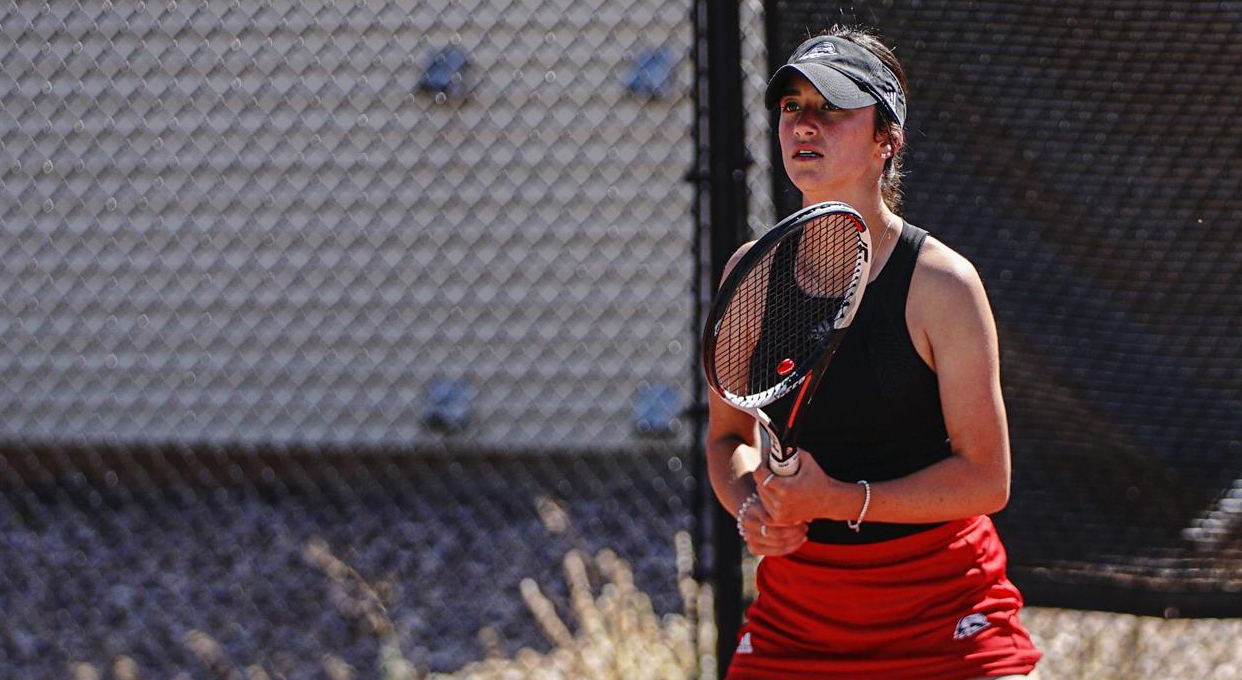
We were excited to talk to local Aussie tennis player Zoe Tanti. She came up through the ranks of Tennis Australia and has made a name for herself to jet off to Southern Utah University where she is playing Division I college tennis and completing a Bachelor’s degree in Exercise Science at the same time. Tanti is no stranger to balancing schoolwork and competitive tennis and all that comes with the commitment to train and study day in and day out from a young age.

“From around the age of 11, I was competing in Australian junior tennis tournaments. I remember on weekends when I used to travel to tournaments around NSW with my sisters and parents,” said Tanti.

Images courtesy of Southern Utah Thunderbirds

We all know that nobody is going to hand you titles or accolades on a silver platter. You have to work for it and have the mentality that there is someone working harder so you have to push yourself more. That is the mentality Zoe Tanti carries with her and it’s that mentality that set her up to be nationally ranked in the top 10 for every age group from under 12’s to 16’s. 

When asked about her transition from the local school to Meriden: An Anglican School for Girls, she spoke fondly about “being a part of such an amazingly talented team and having the opportunity to work with high quality coaches.”

Perhaps a similar line can be drawn alongside professional WTA and ATP players on tour. From grip size to injury prevention, the appropriate racquet size to the string tension for your racquet vs your game, a competitive tennis player needs to have a support group. Zoe Tanti trained with coaches and hit with like minded Meriden girls at Strathfield Sports Club tennis courts. It’s easy to see that when Tanti trained at SSC, it took pure hard work and some to compete at a high junior level nationally and internationally and then some to be on tour.

Travelling with fellow Meriden girls and coaches to ITF and national tournaments was the norm and she thrived in that mix of athletic and academic environment. During her last year as a junior tennis player (aged 18 and under) she reached a ranking of 145 nationally and 753 in the ITF respectively. 

“I enjoyed my time as a junior [tennis] player. Travelling and playing tournaments with my teammates allowed me to make lifelong friends and learn valuable lessons for the next stage in my tennis career.” 

“During my high school years I juggled tennis and academics and with the support and help of the [Meriden] school, I believe it helped my transition to the college tennis environment.” 

It makes sense that at the time of the interview, Tanti spoke about supporting Kyrgios at the Australian Open because he works hard even if he faces a lot of criticism. There are a lot of younger players who look up to him. “If I were rooting for someone it would be Kyrgios because he works hard and is an inspiration to many players out there. I like how he’s not afraid to be different.”

The biggest takeaway from our conversation with Tanti is that no matter what level of competitive tennis you reach as a tennis player in Australia, working for what you want is at the top of the list and that there is always support for those who are willing to accept it.

How to choose the right size junior tennis racquet? | Everything Tennis Blog

Posted on Leave a comment
Junior Tennis Racquet

Every child and teenager grows at a different speed. As each junior tennis player goes through their own growth spurt, their tennis racquet should grow with them as a racquet that is too light or heavy will have negative impacts on their swing. 

So how do parents and coaches guide junior tennis players on this journey based on their ability, physical development and goals? Let’s explore the two main circumstances in which you would begin the process of upgrading a junior tennis racquet in general and then to an adult size – based on their height or age. At that stage, you can help your junior choose the right tennis string for their 26” junior or 27” adult racquet.

How to transition from a junior racquet to an adult racquet?

The first thing you should know is that a full length adult tennis racquet from Wilson, Head, Babolat or Yonex is 27 inches or roughly 69cm. A general rule of thumb is that any junior tennis player should be at least 12 years old depending on their height and strength before considering the switch from a 26” junior racquet to a 27” adult tennis racquet. 

Height of junior tennis player:

A child’s height is a primary factor when choosing the length of the racquet as everyone grows at a different pace and hits a growth spurt at different times. It’s important not to rush the process of switching from a junior racquet to an adult one – the longer the tennis racquet, the tougher it is to train/work with and the more risk of an injury. A big no-no is choosing a racquet that is too heavy. Start light and add lead tape and work your way up (you can’t make a racquet lighter). 

Tip: the racquet should not touch the ground when held by the junior tennis player’s side.

As your child holds the butt cap of the tennis racquet, see if their arm is comfortably extended and that the racquet head is not touching the ground. If he/she has to bend their arm to comfortably rest their hand on the handle or their hand doesn’t reach the handle, try another size.

Below is an infographic that outlines a basic guide based on age and height to the length of the tennis racquet. 

Age/Height Vs Racquet Length Infographic

Each time your child switches to a larger sized racquet, there will be an adjustment period of getting used to a longer racquet, different sweet spot and contact zone compared to their old racquet. A heavier racquet also comes with a slightly slower swing speed until your junior tennis player adjusts. We would definitely suggest allowing a few weeks for them to get used to the new changes. 

Age of junior tennis player:

Junior tennis players between the ages of 2 and 10 should roughly go by the tip mentioned above of standing up straight and holding the bottom of the racquet handle in the palm of their hand. Junior racquets sized between 19 inches (48cm) and 26 inches (66cm) come in different grip sizes and are weighted head heavy to help develop their strokes. 

From the age of 12 upwards, your young competitor may have developed their wrist strength and be ready for a full length 27” (69cm) adult size tennis racquet. Again, let us highlight the importance of choosing lighter than heavier first because you can always add lead tape as they continue to grow in strength but you can’t make a racquet lighter. See our range of junior tennis racquets for your developing tennis player.

CAUTION: 

Bear in mind that longer and heavier racquets require more strength to use. If your junior tennis player does not have the strength, they will compensate by changing their stroke and compromising their technique (using less wrist and lose spin and control). When this happens, the tennis racquet will be closer to their body and he/she will tuck in their arm (losing power in the long run) and risk injury at a tender age.

  • Wrist: strengthening a child’s wrist to use spin on a heavier/longer racquet is doable with wrist-specific drills but it will grow naturally on its own with the proper sized racquet. Valuable lesson time could/should be spent working on more important parts of their game.
  • Arm tucking: A bent arm forehand is an incredibly difficult habit to break. While it doesn’t mean it’s a bad stroke, it isn’t the best and can lead to injury.

If your racquet is too light or is head-heavy, more shock can be transferred to your arm, wrist, elbow and shoulder on ball contact which can also lead to injury. Our blog page will have more information on how to prevent common tennis injuries.